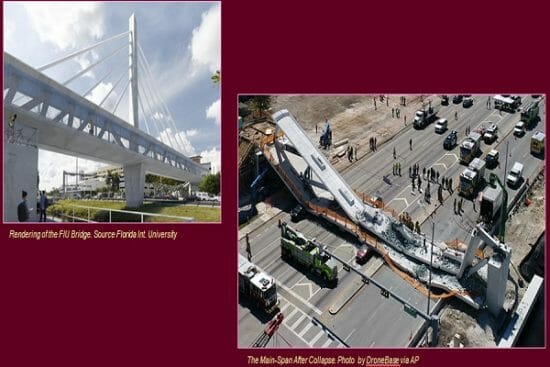
This Engineering Ethics Webinar examines the tragic collapse of the Florida International University (FIU) Pedestrian Bridge on March 15, 2018, which resulted in the loss of six lives and injuries to ten others.
The webinar examines not only the engineering causes of the collapse, but also the ethical decisions that allowed a preventable tragedy to occur.
In the first part of the webinar, Dr. Abolhassan Astaneh-Asl will present the engineering aspects of the bridge’s design, construction, and structural distress prior to collapse. The presentation will review the structural behavior of the post-tensioned concrete truss superstructure, the cracking observed in critical members before failure, and the sequence of engineering decisions that preceded the collapse.
The discussion will also address the design errors in the main-span truss, including violations of the AASHTO LRFD Bridge Design Specifications, and the role of Accelerated Bridge Construction (ABC) used for the project.
The main span utilized a single concrete truss superstructure, a configuration that had not previously been implemented for a bridge of this type. The design also required the span to be constructed using the Accelerated Bridge Construction (ABC) method, adding significant complexity because this structural configuration had never previously been designed or constructed using this approach. The webinar will explain how the bridge was evaluated during various stages of construction and why the analyses performed by the design team were inadequate.
The presentation will also examine the peer-review process conducted by the Louis Berger Group and discuss how the peer review failed to identify critical design deficiencies.
The second part of the webinar focuses on engineering ethics, with particular emphasis on Fundamental Canon 1 of the Code of Ethics for Engineers:
“Engineers shall hold paramount the safety, health, and welfare of the public.”
Although the collapse was ultimately caused by significant engineering design errors, the loss of life could still have been prevented if engineers involved had fully adhered to this fundamental ethical principle.
Dr. Astaneh will review the events from mid-February 2018, when noticeable cracking was first observed, through March 15, 2018, when the bridge collapsed. The presentation will show how multiple opportunities existed for engineers to recognize the severity of the structural distress and protect the public by closing the roadway beneath the bridge and installing temporary shoring.
The webinar will explore how groupthink, organizational pressure, and failure to hold paramount the safety, health, and welfare of the public can lead to catastrophic consequences when engineers do not fully uphold their ethical responsibilities.
References:
- AASHTO LRFD Bridge Design Specifications, 7th Ed. With 2015 Interim Revisions. American Association of State Highway and Transportation Officials, Washington DC.
- ASCE- 2020 Code of Ethics-The American Society of Civil Engineers, https://www.asce.org/-/media/asce-images-and-files/career-and-growth/ethics/documents/asce-code-ethics.pdf
- NSPE Code of Ethics for Engineers. National Society of Professional Engineers (NSPE). https://www.nspe.org/sites/default/files/resources/pdfs/Ethics/CodeofEthics/NSPECodeofEthicsforEngineers.pdf
- NSPE Ethics Reference Guide https://www.nspe.org/sites/default/files/resources/pdfs/Ethics/EthicsReferenceGuide.pdf
- Concepts and Cases-Engineering Ethics, a textbook by Charles E. Harris et al., published by Cengage, 2019.
- Ethics, Technology, and Engineering, a textbook by Ibo van de Poel and Lambèr Royakkers, Wily-Blackwell, 2011.
- The Ethical Executive, a 2010 book by Robert Hoyk and Paul Hersey, Stanford Business Books.
- Florida International University Pedestrian Bridge Collapse Investigation: Assessment of Bridge Design and Performance, prepared for the NTSB by the Federal Highway Administration (AASHTO), Washington, DC. https://data.ntsb.gov/Docket?ProjectID=96877
- Investigation of March 15, 2018, pedestrian bridge collapse at Florida International University, Miami, FL. Washington, DC: U.S. Dept. of Labor, Occupational Safety and Health Administration (OSHA). https://www.osha.gov/sites/default/files/2019-12/2019_r_03.pdf
- Pedestrian Bridge Collapse Over S.W. 8th Street Miami, Florida, March 15, 2018, Accident Report NTSB/HAR-19/02 PB2019-101363, National Transportation Safety Board, Washington, DC. https://www.ntsb.gov/investigations/AccidentReports/Reports/HAR1902.pdf.
- Prestressed Concrete Analysis and Design-Fundamental, 4th Edition, by Antoine E. Naaman and Shih-Ho Chao, 2022. Published by Techno Press 3000, Florida. https://www.technopress3000.com/home
- Stress Ribbon and Cable-supported Pedestrian Bridges-2nd Edition., by Jiri Strasky, ice publishing, Institution of Civil Engineers.
- Designing and Constructing Prestressed Bridges., by Jiri Straski and Radim Necas,)
- Reinforced Concrete, Mechanics and Design, 7th, by James K. Wight, 2016, Pearson Education Limited.
Date: Wednesday. March 25. 2026. Starts: 2 - 4 pm ET
Credits: 2 PDH Units
Learning Objectives
Upon completion of the Webinar, the student should understand
- The structural system used in the FIU pedestrian bridge.
- What Accelerated Bridge Construction (ABC) method was applied to the collapsed main span?
- The structure of the design–construction joint venture team for the FIU bridge project.
- The intended role of independent peer review and how it functioned in this project.
- The failure mechanism that caused the collapse of the FIU bridge.
- Why the collapse could have been prevented during design, peer review, construction, or inspection stages.
- The role of inadequate peer review in the tragic collapse.
- The role of the lack of proper oversight during the project.
- How violations of the Engineering Code of Ethics contributed to the loss of six lives and injuries to ten others.
- How groupthink and organizational pressure can prevent engineers from holding public safety paramount.
- Charles E. Harris’s concept of Preventive Ethics.
Special Webinar Instructions
After payment, please visit this webinar page, click "Start Course" and fill out the Webinar Registration Form. You'll receive email notification and details on how to join the webinar. You will then be able to access the webinar slides, test your system and receive webinar reminders. After completing the webinar requirements, your certificate of completion will be saved and available for download in your profile.
We value your feedback! Please rate this webinar after completion.
Group Discounts Available
Biography:
Abolhassan Astaneh-Asl, Ph.D., P.E.
Dr. Abolhassan Astaneh-Asl is Professor Emeritus of Civil and Environmental Engineering at the University of California, Berkeley, and the 2013 Minner Faculty Fello.
w in Engineering Ethics and Social/Professional Responsibility in the College of Engineering.
He is the recipient of the 1998 T.R. Higgins Lectureship Award from the American Institute of Steel Construction, one of the most prestigious honors in structural engineering.
Dr. Astaneh is a licensed Professional Civil Engineer (P.E.) in California and currently works as a structural, earthquake, and bridge engineering consultant and expert witness. Over a career spanning more than 57 years, he has conducted teaching, research, design, and consulting on steel, concrete, composite, and timber structures.
He has been involved in the design and study of major structures, including long-span bridges such as the Golden Gate Bridge and San Francisco–Oakland Bay Bridge, as well as high-rise buildings up to 73 stories.
Dr. Astaneh has conducted failure analysis of several major structural collapses, including the World Trade Center Towers, the I-35W Bridge collapse in Minnesota, the I-5 Skagit River Bridge in Washington, and the FIU Pedestrian Bridge collapse in Florida.
He has authored more than 300 technical publications and has delivered hundreds of lectures, seminars, and webinars on structural engineering, earthquake engineering, and engineering ethics. He has authored more than 300 technical publications and has delivered hundreds of lectures, seminars, and webinars on structural engineering, earthquake engineering, and engineering ethics.











excellent course
great case study and great presenter
A good course presenting detailed descriptions of root-cause failures leading to the collapse. Especially impactful were the deliberate, thoughtful pauses to deeply consider crucial ethical questions. The course effectively explored the probable and possible factors that caused critical decisions to ultimately be the wrong decisions, and conveyed clearly the need for ethical actions at every juncture. Lastly, it is appreciated that the course respectfully considered the gravity of the loss of life resulting from the collapse.
Well done. Good example displaying ethical issues.
Excellent course. Learned a lot about the structure even after following it online. And a lot about responsibilities.
No comments at this time
Dr. Astaneh-Asi is well versed on this topic and the particulars of the FIU bridge and presented it well. I highly recommend it.
Very good course on ethics in engineering. Highly recommend.
Excellent !
Great overview and well prepared
Decent material covered in the seminar, but it needs to be more focused in order to stay within the two hours., and not skip through the ending slides.
Very interesting content. Presentation could have been a little more concise. Speaker rambled a bit and seemed judgemental in presenting his opinions.
interesting content, good presentation
Interesting case study, but a little hard to follow for me as a non-civil engineer because there was quite a presumption about the level of knowledge one should have regarding bridge design and other structures made of steel and concrete.
For a course on ethics, there was an awful lot of judgement passed based on speculation and opinion with very little substantive information and inadequate knowledge pertaining to the specific events.