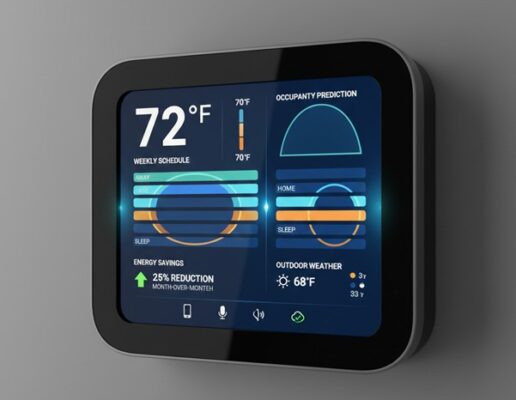
Smart HVAC controls and automation represent transformative technologies fundamentally improving building performance across energy efficiency, operational costs, occupant comfort, and environmental sustainability. This course provides comprehensive knowledge of intelligent building climate control systems, from foundational sensor and controller components through advanced machine learning optimization.
The course examines control strategies ranging from PID algorithms and optimal start/stop sequences to demand-based ventilation and zone-level VAV management. Machine learning applications including model predictive control, occupancy prediction, and automated fault detection demonstrate how artificial intelligence enables unprecedented optimization. Communication infrastructure receives detailed coverage, including BACnet protocols, Modbus integration, and wireless sensor networks.
Implementation guidance addresses the complete project lifecycle: design phase specification of control objectives and system architecture, installation best practices ensuring proper sensor placement and network reliability, commissioning procedures verifying functional performance, and operator training ensuring sustained optimization. Cybersecurity considerations protect building automation systems from increasingly sophisticated cyber threats.
Participants gain practical knowledge to specify, implement, and operate smart HVAC systems that deliver documented energy savings of 15-30%, maintenance cost reductions of 20-40%, and improved occupant satisfaction while supporting organizational sustainability goals. The course serves mechanical engineers, facility managers, and technical professionals responsible for modern building HVAC systems.
This course is designed for mechanical engineers, HVAC designers, facility managers, building automation professionals, and technical staff responsible for specifying, implementing, or operating building climate control systems. Participants should have basic understanding of HVAC system fundamentals and building mechanical systems.
Learning Objectives:
At the successful conclusion of this course, you will learn the following knowledge and skills:
- Understanding the core components of smart HVAC systems including distributed sensor networks, microprocessor-based controllers, variable frequency drives and modulating actuators, and integrated software platforms combining building automation systems with cloud analytics for real-time optimization
- Quantifying documented performance improvements from smart controls implementation, including energy consumption reductions of 15-30%, maintenance cost savings of 20-40%, thermal comfort improvements achieving ±1°F setpoint precision, and indoor air quality enhancements delivering cognitive function increases of 60%
- Applying proportional-integral-derivative (PID) control fundamentals for HVAC temperature, pressure, and flow regulation, including tuning methodologies and auto-tuning algorithms that adapt parameters based on operating conditions without manual intervention
- Implementing optimal start/stop control strategies that learn building thermal response characteristics, calculate minimum required pre-occupancy runtime based on current conditions, and enable controlled temperature drift before unoccupied periods to reduce runtime by 10-30%
- Designing demand-based ventilation systems using CO2 sensors to adjust outdoor air based on actual occupancy, and economizer control sequences that leverage outdoor air for free cooling, understanding energy savings potential of 10-40% and 10-50% respectively
- Configuring zone-level control with pressure-independent VAV terminal boxes, static pressure reset algorithms reducing fan energy by 20-50%, and occupancy-based temperature and ventilation setback strategies for variable-use spaces
- Evaluating machine learning applications including model predictive control forecasting loads days ahead, occupancy prediction algorithms achieving 90% accuracy for regular patterns, and fault detection systems identifying 80-90% of equipment degradation within days or weeks of occurrence
- Selecting appropriate communication protocols including BACnet/IP and BACnet MS/TP for multi-vendor integration, Modbus RTU and TCP for legacy equipment, and wireless technologies (ZigBee, WiFi, LoRaWAN) based on application requirements and installation constraints
- Specifying design requirements including comprehensive point schedules, detailed control sequence narratives for all operating modes, network architecture with 15-20% expansion capacity, and cybersecurity measures including encryption, network segmentation, and authentication protocols
- Executing commissioning procedures following ASHRAE Guidelines including functional performance testing of control sequences under all conditions, sensor calibration verification, energy baseline establishment, comprehensive operator training, and documentation deliverables ensuring successful long-term operation