


No data found for Custom Course Number
No data found for Custom Course Units
Intended Audience: Civil & Water Engineers
PDH UNITS: 2
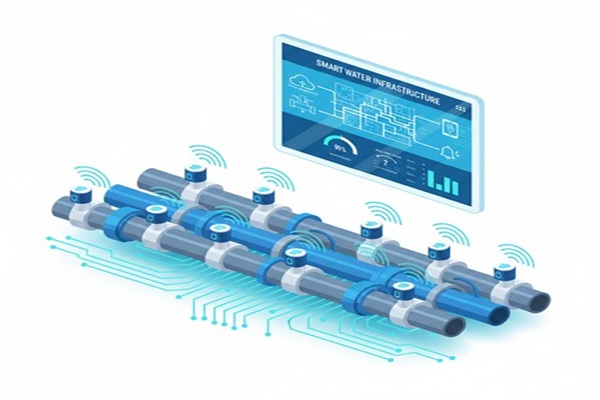
Water infrastructure systems worldwide face a critical challenge with non-revenue water losses that can exceed 30 to 50 percent in many municipalities. The World Bank estimates that utilities globally lose approximately 126 billion cubic meters of treated water annually, representing financial losses exceeding $39 billion. Traditional leak detection methods relying on manual inspection and acoustic listening devices suffer from significant limitations including high labor costs, detection times measured in weeks, and identification of only 60 to 70 percent of leaks. The Internet of Things (IoT) has emerged as a transformative technology enabling continuous surveillance of distribution networks through intelligent sensor networks.
By completing this course, you will gain practical knowledge of IoT-based water leak detection systems that can identify anomalies within minutes rather than weeks, locate leaks with precision measured in meters, and reduce water losses by 20 to 40 percent. Research by the Water Research Foundation indicates that well-implemented IoT leak detection programs achieve return on investment within 2 to 4 years through water loss reductions alone. Studies demonstrate that machine learning algorithms applied to sensor data can achieve leak detection accuracy exceeding 95 percent with false positive rates below 5 percent.
This course bridges the gap between emerging IoT technologies and practical water utility applications, examining sensor technologies including acoustic sensors, flow meters, pressure loggers, and fiber optic distributed sensing. Communication network technologies including LoRaWAN, NB-IoT, and LTE-M that enable reliable data transmission from underground infrastructure are covered in detail. Machine learning applications for anomaly detection and leak localization are examined, along with implementation strategies, integration requirements, and case studies demonstrating quantified benefits from both metropolitan utilities and rural water systems. Whether you are a civil engineer, water utility manager, or infrastructure professional, this course will equip you with the knowledge needed to evaluate and implement IoT-based leak detection programs.
Course Benefits
- Gain cutting-edge knowledge in smart water infrastructure technologies
- Learn practical implementation strategies from real-world case studies
- Understand sensor technologies and communication networks for water monitoring
- Prepare for future IoT and AI applications in water infrastructure
- Enhance professional credentials with specialized knowledge
- Flexible learning format accommodates busy professional schedules
Target Audience
This course is designed for:- Civil engineers working in water infrastructure
- Water utility managers and operations professionals
- Municipal engineers and public works directors
- Smart city technology professionals
- Engineering consultants and system integrators
- Asset management and GIS professionals
Learning Objectives:
At the successful conclusion of this course, you will learn the following knowledge and skills:- Explain the global water loss challenge facing utilities, quantify non-revenue water impacts, and describe how IoT technologies address limitations of traditional leak detection methods including manual inspection and periodic acoustic surveys.
- Describe the four-layer IoT architecture for water systems including perception, network, processing, and application layers, and identify the functions and technologies applicable at each architectural level.
- Explain acoustic leak detection principles including frequency characteristics for different pipe materials, hydrophone versus accelerometer sensor technologies, and correlation techniques for precise leak localization.
- Describe flow and pressure monitoring techniques including district metered areas, minimum night flow analysis, electromagnetic and ultrasonic flow measurement, and advanced meter infrastructure applications for leak detection.
- Identify emerging sensor technologies including fiber optic distributed acoustic sensing, distributed temperature sensing, chemical sensors, and satellite-based detection methods for large-scale water infrastructure monitoring.
- Compare low-power wide-area network technologies including LoRaWAN, NB-IoT, and LTE-M based on range, power consumption, data rates, and cost characteristics for water infrastructure applications.
- Explain data processing pipelines including data cleaning, feature engineering, and machine learning approaches for anomaly detection using supervised learning, unsupervised learning, and deep learning neural networks.
- Describe leak localization algorithms including acoustic correlation, model-based approaches, and graph neural networks that determine probable leak locations within distribution networks.
- Identify integration requirements with utility enterprise systems including GIS, work order management, SCADA, and customer information systems to maximize operational value of leak detection data.
- Evaluate implementation strategies including phased deployment, pilot projects, training programs, and performance measurement, drawing on documented case studies demonstrating quantified benefits of IoT leak detection deployment.
Once completed, your order and certificate of completion will be available in your profile when you’re logged in to the site.