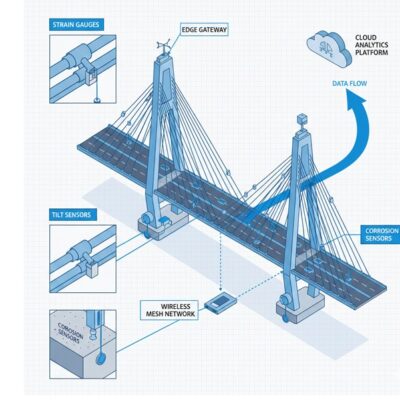
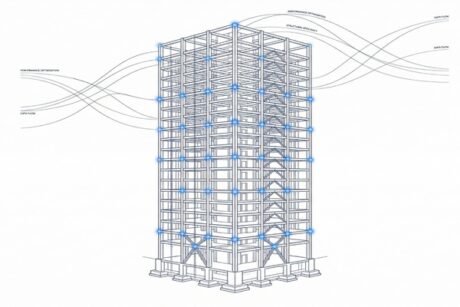
The structural integrity of buildings, bridges, dams, and other critical infrastructure represents a fundamental public safety concern. Traditional structural inspection methods rely on periodic visual assessments and manual testing that provide only snapshots of structural condition at discrete moments. These approaches cannot detect gradual deterioration between inspection intervals, may miss critical damage in inaccessible locations, and require significant time and expense to execute comprehensively.
The Internet of Things (IoT) has emerged as a transformative technology for structural health monitoring, enabling continuous real-time assessment of structural performance through networks of interconnected sensors, data transmission systems, and analytical platforms. IoT-based monitoring systems can detect subtle changes in structural behavior, identify emerging damage before it becomes critical, and provide engineers with unprecedented insights into how structures respond to environmental loads, operational demands, and aging processes.
According to the American Society of Civil Engineers, the United States faces a USD 2.6 trillion infrastructure funding gap over the next decade. Research by McKinsey Global Institute indicates that IoT-based monitoring systems can reduce infrastructure maintenance costs by 20 to 30 percent while extending asset service life by 15 to 25 percent through early damage detection and optimized maintenance timing. The Federal Highway Administration reports that continuous monitoring systems can reduce bridge inspection costs by 40 to 60 percent compared to traditional hands-on inspection methods while providing superior damage detection capabilities.
This course provides comprehensive coverage of IoT applications in structural health monitoring for civil engineers, structural engineers, and infrastructure professionals. You will learn how wireless sensor networks, data acquisition systems, cloud computing platforms, and analytical algorithms work together to provide continuous structural assessment. The course examines sensor technologies for measuring strain, displacement, vibration, corrosion, and environmental conditions. You will understand data transmission protocols, power management strategies, and edge computing architectures that enable reliable long-term monitoring. The course covers advanced analytical techniques including machine learning for damage detection, digital twin implementations, and predictive maintenance strategies.
Learning Objectives:
At the successful conclusion of this course, you will learn the following knowledge and skills:
- Explain the evolution of structural monitoring approaches from traditional visual inspection through manual instrumentation and wired continuous monitoring to IoT-based wireless systems, and describe the four-layer IoT architecture including sensor, network, data management, and analytics layers with their respective functions.
- Identify and compare strain measurement sensor technologies including electrical resistance strain gauges, fiber Bragg grating sensors, vibrating wire gauges, and wireless strain gauges, describing operating principles, measurement resolution, long-term stability characteristics, and suitable applications for each sensor type.
- Describe displacement and deformation sensors including LVDTs, laser distance sensors, GNSS receivers, and tilt sensors/inclinometers, explaining measurement principles, accuracy levels, contact versus non-contact operation, and applications for monitoring bridge deflection, settlement, and structural movement.
- Explain vibration and dynamic response measurement using piezoelectric and MEMS accelerometers, operational modal analysis techniques for extracting natural frequencies and mode shapes, and damage detection through modal property changes indicating stiffness reduction or connection deterioration.
- Describe corrosion and material degradation monitoring technologies including half-cell potential sensors, chloride ion sensors, linear polarization resistance sensors, acoustic emission sensors, and embedded humidity/temperature sensors for assessing electrochemical deterioration processes.
- Compare low-power wide-area network technologies for structural monitoring including LoRaWAN, NB-IoT, and Sigfox protocols, analyzing transmission range, power consumption, battery life, spectrum usage, network topology, and suitability for different monitoring deployment scenarios.
- Explain wireless mesh network architectures using IEEE 802.15.4-based protocols including Zigbee, Thread, WirelessHART, and ISA100.11a, describing multi-hop communication, self-healing mechanisms, time-synchronized channel hopping, and design considerations for coverage, reliability, and power management.
- Describe edge computing architectures for structural monitoring including sensor-level data processing for aggregation and feature extraction, gateway edge analytics for machine learning inference and modal analysis, and cloud platform integration using AWS IoT Greengrass, Azure IoT Edge, or Google Cloud IoT Edge frameworks.
- Identify power management strategies including duty cycling, adaptive sampling, event-triggered operation, primary battery selection (lithium thionyl chloride, lithium manganese dioxide, alkaline), and energy harvesting technologies using solar photovoltaic, vibration, thermoelectric, or RF energy sources.
- Explain time-series database systems for sensor data management including InfluxDB, TimescaleDB, and Prometheus, describing compression algorithms, data retention policies, ingestion pipeline architecture, and integration with cloud IoT platforms such as AWS IoT Core and Microsoft Azure IoT Hub.
- Describe data security and privacy requirements including device authentication using X.509 certificates, data encryption during transmission using TLS and at-rest using AES-256, role-based access control policies, audit logging, and compliance with NIST Cybersecurity Framework guidance.
- Apply machine learning algorithms for anomaly detection including autoencoders, one-class support vector machines, isolation forests, ARIMA models, and LSTM neural networks, explaining how these techniques identify deviations from normal structural behavior potentially indicating damage or sensor malfunction.
- Explain damage classification and localization techniques using supervised machine learning with support vector machines, random forests, and convolutional neural networks, describing feature extraction, training data requirements, model-based localization methods, and hybrid physics-informed data-driven approaches.
- Describe predictive maintenance methodologies including physics-based degradation models (fatigue crack growth, corrosion), machine learning approaches for remaining useful life prediction, uncertainty quantification using Bayesian methods, and risk-based decision frameworks for optimizing maintenance timing.
- Explain digital twin implementation combining real-time monitoring data with BIM geometric models, finite element physics-based analysis, cloud analytics platforms, and visualization tools to enable comprehensive structural assessment, scenario simulation, and data-driven infrastructure management decisions.
 TP - 1192 An Introduction to Hazardous Groundwater Remediation by Precipitation for Professional Engineers
1 × $4.99
TP - 1192 An Introduction to Hazardous Groundwater Remediation by Precipitation for Professional Engineers
1 × $4.99 

 TP - 1192 An Introduction to Hazardous Groundwater Remediation by Precipitation for Professional Engineers
1 × $4.99
TP - 1192 An Introduction to Hazardous Groundwater Remediation by Precipitation for Professional Engineers
1 × $4.99