




No data found for Custom Course Number
No data found for Custom Course Units
Intended Audience:: Civil, Building, Transportation, and Utility Engineers
PDH UNITS: 2
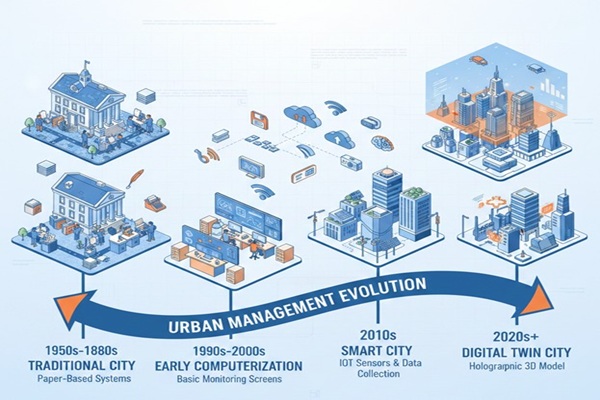
This comprehensive course introduces civil engineers and urban infrastructure professionals to digital twin technology and its transformative applications in smart city development. As global urbanization accelerates toward 68 percent of world population residing in cities by 2050, traditional infrastructure management approaches increasingly struggle to address the complexity of interconnected urban systems. Digital twins offer a powerful solution by creating virtual replicas of physical infrastructure that enable real-time monitoring, predictive simulation, and optimization at scales previously impossible.
Participants will explore the fundamental concepts, enabling technologies, and implementation strategies for urban digital twins across transportation, energy, water, and building systems. The course examines how Internet of Things sensor networks, data integration platforms, cloud computing, and artificial intelligence work together to create living virtual models of cities. Through analysis of leading implementations including Singapore's Virtual Singapore, Helsinki's 3D city model, and New York City's distributed digital twin ecosystem, participants will learn practical approaches for deploying these technologies in their own projects and organizations.
Research indicates that digital twin implementations can improve urban infrastructure efficiency by 15 to 30 percent while reducing operational costs by 10 to 25 percent, delivering compelling returns that have motivated rapid adoption across forward-thinking municipalities worldwide.
Course Benefits
- Gain comprehensive understanding of digital twin technology for smart cities
- Learn practical implementation strategies from real-world case studies
- Understand IoT, data integration, and AI applications for urban systems
- Explore governance frameworks and data management best practices
- Prepare for emerging trends in urban digital infrastructure
- Enhance professional credentials with specialized knowledge in smart city technologies
Target Audience
This course is designed for:- Civil engineers working on urban infrastructure projects
- Transportation engineers and planners
- Utility system engineers and operators
- Municipal engineers and public works officials
- Smart city technology professionals
- Infrastructure asset managers
- GIS and data management professionals
Learning Objectives:
At the successful conclusion of this course, you will learn the following knowledge and skills:- Define digital twins and explain how they differ from traditional monitoring and simulation systems, describing the key characteristics including bidirectional connectivity, temporal integration, multi-domain integration, and scalability that enable advanced urban management capabilities.
- Describe the enabling technologies for urban digital twins including Internet of Things sensor networks, data integration platforms, cloud computing infrastructure, and communication systems, explaining how these components work together to create comprehensive urban models.
- Explain data management requirements for urban digital twins including time-series databases, geospatial databases, semantic data modeling, data quality management, and interoperability standards such as CityGML.
- Describe transportation network digital twin applications including real-time traffic state estimation, predictive traffic forecasting, and signal optimization, explaining how machine learning models achieve prediction accuracy and support operational decisions.
- Explain energy and utility system digital twin applications including electric grid modeling, water distribution network monitoring, and district energy system optimization, describing how these applications improve efficiency and reliability.
- Describe machine learning applications for urban digital twins including supervised learning for prediction, deep learning architectures for spatial and temporal patterns, computer vision for infrastructure inspection, and predictive maintenance for asset management.
- Analyze implementation case studies from leading smart city initiatives including Singapore Virtual Singapore, Helsinki 3D City Model, and New York City digital twin programs, identifying success factors and lessons learned.
- Explain implementation strategies including governance frameworks, data governance policies, procurement approaches, legacy system integration, and technical interoperability standards required for successful digital twin deployments.
- Describe privacy, security, and ethical considerations for urban digital twins including privacy-preserving techniques, cybersecurity protections, and defense-in-depth strategies that protect sensitive urban data.
- Identify emerging applications and future trends including autonomous systems integration, climate resilience applications, carbon emissions tracking, and citizen engagement platforms that will shape the evolution of urban digital twins.
Once completed, your order and certificate of completion will be available in your profile when you’re logged in to the site.