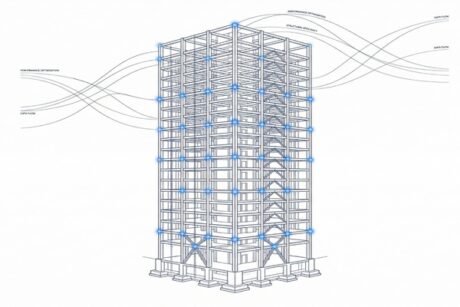
Architectural space planning is one of the most influential stages of the design process, setting the organizational framework that determines how buildings perform and how people experience them. As projects grow more complex and expectations for efficiency, adaptability, and performance continue to rise, generative artificial intelligence is redefining how designers approach space planning. This comprehensive course introduces building professionals to the practical application of AI-driven generative design tools for architectural space planning.
Designed for architects, interior designers, urban planners, and facility managers, this course provides the foundational knowledge needed to understand, evaluate, and confidently integrate AI-powered space planning solutions into professional workflows. Participants will discover how AI systems can rapidly generate and assess thousands of layout options, balance multiple and often competing design objectives, and uncover high-performing solutions that would be difficult—or impossible—to identify through manual iteration alone.
Studies show that AI-optimized layouts can deliver 8–15% improvements in space efficiency, while firms adopting generative design report 40–60% reductions in schematic design timelines for suitable project types. These gains allow design teams to focus less on repetitive iteration and more on strategic decision-making, creativity, and client value.
Bridging advanced technology with real-world architectural practice, the course explores constraint-based generation, multi-objective optimization, machine learning, and reinforcement learning techniques for layout optimization. You will learn how leading platforms such as Autodesk Forma, TestFit, Finch 3D, and Hypar apply these methods across diverse building types—including offices, healthcare facilities, educational environments, and multi-family residential projects. Through case studies, the course demonstrates measurable outcomes such as improved adjacency, shorter travel distances, enhanced daylight access, and increased space utilization.
By the end of the course, you will be prepared to leverage generative AI space planning tools effectively while maintaining the professional judgment, design intent, and responsibility that remain central to high-quality architectural practice.
Learning Objectives:
At the successful conclusion of this course, you will learn the following knowledge and skills:
- Describe the evolution of architectural space planning from manual techniques through CAD, BIM, and computational design to current AI-driven approaches, and explain how each technological advancement expanded design capabilities.
- Define generative artificial intelligence and explain how evolutionary algorithms, deep learning models, graph neural networks, and reinforcement learning contribute to architectural space planning capabilities.
- Explain the fundamental concepts of spatial relationships and adjacency requirements, including how to develop adjacency matrices that encode functional relationships, workflow requirements, and user experience considerations.
- Describe circulation and flow optimization principles including primary, secondary, and tertiary circulation systems, and explain how space syntax analysis provides quantitative measures of circulation quality.
- Identify building code requirements including egress distances, corridor widths, and accessibility standards that constrain space planning, and explain how AI tools incorporate code compliance as generation constraints.
- Explain key space planning performance metrics including space efficiency ratios, daylight factors, and view quality measures, and describe how these metrics enable objective evaluation of AI-generated layouts.
- Describe constraint-based layout generation including hard and soft constraints, constraint propagation algorithms, and how these approaches define feasible solution spaces for space planning optimization.
- Explain multi-objective optimization techniques including genetic algorithms, NSGA-II, and particle swarm optimization, and describe how the Pareto frontier concept helps navigate tradeoffs between competing objectives.
- Compare leading commercial AI space planning platforms including Autodesk Forma, TestFit, Finch 3D, and Hypar, identifying their key capabilities, target applications, and BIM integration approaches.
- Identify professional practice considerations for AI-assisted space planning including design authorship, professional responsibility, client communication, and intellectual property considerations.