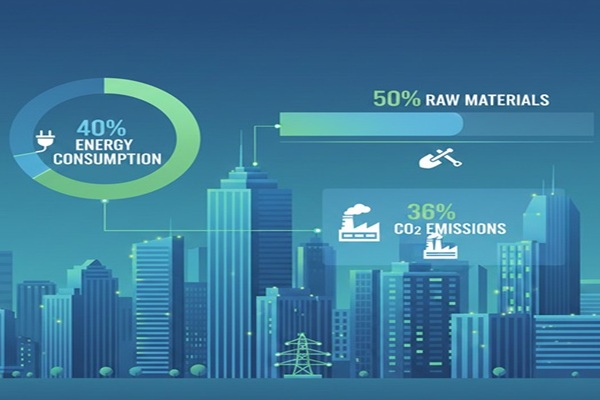
The built environment accounts for approximately 40 percent of global energy consumption and 36 percent of energy-related carbon dioxide emissions according to the United Nations Environment Programme. These statistics underscore the critical importance of systematic approaches to evaluating and reducing environmental impacts throughout a building's entire life span. Whole Building Life Cycle Assessment (WBLCA) provides the comprehensive methodology needed to quantify and minimize these impacts from material extraction through end-of-life disposition.
Traditional approaches to sustainable building design often focus narrowly on operational energy efficiency,
addressing only a portion of a building's total environmental footprint. While operational energy remains significant, research consistently demonstrates that embodied impacts from materials, construction, and end-of-life processes can represent 20 to 80 percent of a building's total life cycle impacts, depending on building type, energy efficiency, and grid carbon intensity. As buildings become more energy efficient and electrical grids decarbonize, embodied impacts assume increasing relative importance.
This comprehensive course introduces professionals to WBLCA fundamentals, standards, and practical applications. Participants will learn the ISO 14040 framework that establishes the internationally recognized methodology for life cycle assessments, and how building-specific standards including EN 15978 and ASTM E2921 adapt this framework for whole building applications. The course covers all life cycle stages from raw material extraction through end-of-life, including product stage embodied impacts, construction activities, operational energy and water use, maintenance cycles, and material fate scenarios including recycling and disposal.
By completing this course, you will gain practical insights into how WBLCA tools including Tally, Athena Impact Estimator for Buildings, One Click LCA, and EC3 enable quantitative environmental assessment throughout the design process. Research by the Carbon Leadership Forum demonstrates that up to 80 percent of a building's embodied carbon is determined by decisions made during schematic design, emphasizing the importance of early-stage assessment integration. The course examines design strategies for reducing building life cycle impacts through structural system optimization, envelope tradeoff analysis, and material specification approaches that can achieve embodied carbon reductions of 20 to 50 percent.
The course addresses WBLCA requirements in green building certification systems including LEED v4.1 and emerging embodied carbon codes in California, Vancouver, and the European Union. Whether you are an engineer, architect, sustainability consultant, or building owner pursuing environmental performance optimization, this course provides the knowledge foundation for effective whole building environmental assessment and design decision-making
Learning Objectives:
At the successful conclusion of this course, you will learn the following knowledge and skills:
- Explain the purpose and scope of Whole Building Life Cycle Assessment (WBLCA), including its role in quantifying environmental impacts across all building life stages and its increasing importance as operational energy decreases relative to embodied impacts.
- Describe the ISO 14040 life cycle assessment framework including the four phases of goal and scope definition, inventory analysis, impact assessment, and interpretation, and explain how building-specific standards EN 15978 and ASTM E2921 adapt this framework for whole building applications.
- Identify the seven primary environmental impact categories evaluated in WBLCA including Global Warming Potential, Ozone Depletion Potential, Acidification Potential, Eutrophication Potential, Smog Formation Potential, Resource Depletion, and Water Consumption.
- Explain the EN 15978 modular framework for building life cycle stages including Product Stage (A1-A3), Construction Stage (A4-A5), Use Stage (B1-B7), End of Life Stage (C1-C4), and Module D benefits beyond system boundary.
- Describe Environmental Product Declarations (EPDs) including their structure, program operators, and application in WBLCA, and explain the data source hierarchy from manufacturer-specific EPDs through industry-average EPDs to generic databases.
- Compare embodied carbon characteristics of major structural materials including concrete, steel, aluminum, and mass timber, and explain how material selection and specification can reduce structural system embodied carbon by 20 to 50 percent.
- Identify leading WBLCA software platforms including Tally, Athena IE4B, One Click LCA, and EC3, and describe their capabilities for BIM integration, database access, and certification compliance documentation.
- Apply design strategies for reducing whole building life cycle impacts including structural system optimization, envelope tradeoff analysis, concrete mix specification, and steel sourcing requirements.
- Explain WBLCA requirements in green building certification systems including LEED v4.1 Building Life-Cycle Impact Reduction credit structure, baseline building requirements, and documentation requirements.
- Evaluate emerging trends in WBLCA including embodied carbon building codes, biogenic carbon accounting methodologies, digital twin integration, and circular economy design strategies.