


No data found for Custom Course Number
No data found for Custom Course Units
Intended Audience: civil engineers, environmental engineers, chemical engineers, and water treatment plant managers and operators.
PDH UNITS: 4
Elements & Design Principles of Water Supply Systems
Discover the best practices for the design, planning and analysis of various water supply systems. Dive into the essential elements and design principles in this online course curated by Dr. Karim, P.E., M.ASCE. The broad objectives underlying any water supply system are:- To supply safe and wholesome water to consumers.
- To supply water in adequate quantity.
- To make water easily available to consumers so as to encourage personal and household cleanliness.
Course Outline
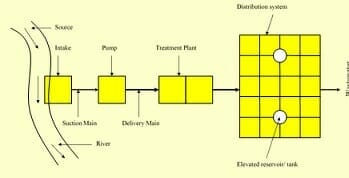
This course will start off with an overview of the two primary types of water sources and the suitability of surface and ground water with regards to quantity AND quality We'll then discuss the essential components and inter-workings of water supply collection systems designed to convey water from a source to the treatment system. Within this discussion, we'll cover the best practices for design and on-site implementation (e.g. where to locate, considerations for intake and transmission mains, etc.). We'll then jump into treatment plants in terms of their functionality and treatment methodologies/ approaches (i.e. screening, sedimentation, treatment with chemicals, filtration through sand beds, and disinfection to kill microorganisms). The different classifications of distribution plants (e.g. gravity systems vs. systems with direct pumping vs. systems with pumping and storage, aka duel systems) and methods of supply are also covered. Additionally, this discussion will cover pressure requirements for distribution pipes, as well as the main components and different types of reservoirs. We'll also examine the mathematical equations involved in calculating the most economic dimension of a cylindrical reservoir or water supply tank. The basic requirements, 4 primary elements and design principles of distribution pipe systems is also outlined in order to help you obtain maximum system strength and corrosion resistance. This description also walks through the advantages and disadvantages of different distribution system layouts (e.g. dead end systems, grid iron systems, circle or "ring" systems and radial systems) and designs of distribution systems layouts/designs. We'll then jump into the factors causing loss of pressure head and the essential appurtenances in distribution systems. This PDH engineering course concludes with a discussion of the best practices for the analysis and planning of water supply systems.Learning Objectives
At the successful conclusion of this course, you’ll be able to:- Define a public water system and the components of wholesome water and potable water.
- Identify the basic elements of a water supply system.
- Determine the main sources of water supply.
- Differentiate a water collection system, water treatment system and distribution system.
- Identify pressure requirements for various stages of water use.
- Analyze the design the overhead storage tanks.
ACCEPTANCE GUARANTEE
Ncite Engineering Hub engineering courses & live webinars meet NCEES Guidelines for Professional Engineer licenses renewal in all 50 states.

Live Webinars satisfy strict “Live Contact Hour” state mandates.
100% money-back State Board Acceptance Guarantee
Ncite Engineering Hub will refund your payment if the PDH credits you earn are rejected by your state board for any reason.

Ethics Courses

E – 2012 Engineering Ethics—Case Studies in Briberyby Mark P. Rossow, PhD, P.E.

E – 1865 Engineering Ethics: The Cases of Challenger and Columbia Shuttle Disasters; “Hold Safety Paramount” to Prevent Loss of Lifeby Dr. Abolhassan Astaneh-Asl, Professor Emeritus. Ph.D., PE

E – 1193 – Ethical Issues in Design Buildby Mr. J. Paul Guyer, P.E., R.A.

E – 2090 Ethical Engineering Practices and Case Studies; Modern Ethical Challengesby Steven Vitale. Ph.D., P.E.
Once completed, your order and certificate of completion will be available in your profile when you’re logged in to the site.
Course No E - 1411
PDH Units 4.00