






• No products in the cart.

Profile Photo

No data found for Custom Course Number

No data found for Custom Course Units

$75.00

Profile Photo
$75.00

Intended Audience: engineers and architects who want an understanding of the fundamentals of acoustics

PDH UNITS: 3

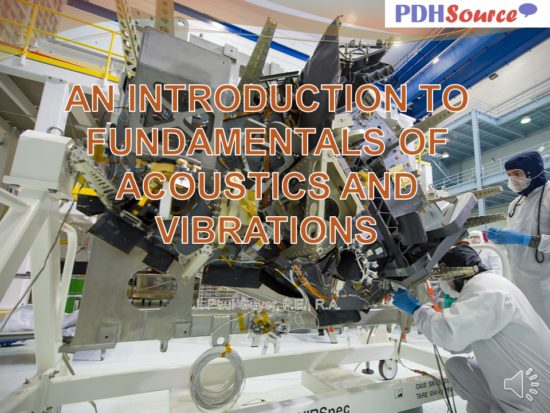
This course will introduce you to the basic principles and terminology of acoustics. You will learn about sound pressure levels, sound power levels, sound intensity levels, vibration levels, frequency, temporal variations, loudness, vibration transmissibility and vibration isolation. This course will give you definitions of fundamental acoustic properties. You will learn how they are calculated, utilized, and applied to a variety of noise and sound engineering situations you will encounter in your daily practice. This information will prepare you to address many design and analysis issues associated with buildings and the environment. This course is intended for engineers and architects who want an understanding of the fundamentals of acoustics, including terminology, definitions and calculation of fundamental acoustic properties. Here are topics that will be covered: • DECIBELS o Definition and use o Decibel addition o Decibel subtraction o Decibel averaging • SOUND PRESSURE LEVEL o Definition, sound pressure level o Definition, reference pressure o Abbreviations o Limitations on use of sound pressure level • SOUND POWER LEVEL o Definition, sound power level o Definition, reference power o Abbreviations o Limitations on sound power level data • SOUND INTENSITY LEVEL o Definition, sound intensity level o Definition, reference intensity o Notation o Computation of sound power level from intensity level o Determination of sound intensity • VIBRATION LEVELS o Definition, vibration level o Definition, reference vibration o Abbreviations • FREQUENCY o Frequency unit, hertz o Discrete frequencies, tonal components o Octave frequency bands o Octave band levels (1/3) o A-, B- and C-weighted sound levels o Calculation of A-weighted sound level • TEMPORAL VARIATIONS • SPEED OF SOUND AND WAVELENGTH o Temperature effect o Wavelength • LOUDNESS o Loundness judgments o Sons and phons • VIBRATION TRANSMISSIBILITY o Isolation efficiency • VIBRATION ISOLATION EFFECTIVENESS o Static deflection of a mounting system o Natural frequency of a mount o Application suggestions

Learning Objectives

At the successful conclusion of this course, you’ll be able to identify and discuss:
  • Learn the definition of a decibel and how it is calculated
  • Learn how to add, subtract and average decibel levels
  • Learn the definition of and how to calculate sound pressure level
  • Learn the definition of and how to calculate sound power level
  • Learn the definition of and how to calculate sound intensity level
  • Learn the definition of A-, B- and C-weighted sound levels and how they are applied

Course No E - 1363
PDH Units 3.00
Copyright 2025 · All Rights Reserved. Ncite Engineering Hub, LLC 513 E- Main Street # 981 Charlottesville, VA 22902 USA