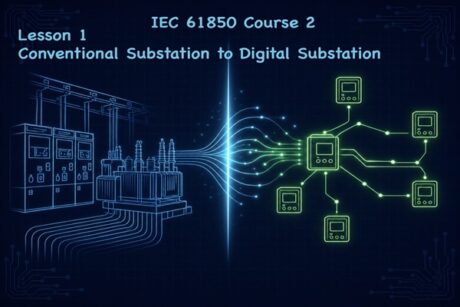
A plain-language course on protecting IEC 61850 digital substations from cyber threats with the IEC 62351 security standard. It covers threat modelling, securing GOOSE, Sampled Values, and MMS, network hardening, monitoring, time-synchronization security, NERC CIP compliance, and incident response.
Digital substations rely on computer messages to protect, control, and monitor the power system. That makes them powerful, but it also exposes them to people who might want to interfere with them, spy on them, or damage them. This course asks a new question: now that all this digital communication exists, how do we keep it safe?
The course is taught from a protection engineer's point of view, not a generic Information Technology (IT) security view. It starts by explaining why substations need their own cybersecurity model. In Operational Technology (OT), availability and integrity usually come before confidentiality, and real incidents such as the 2015 and 2016 attacks on the Ukrainian grid show what is at stake. Students then look at the substation the way an attacker would and threat-model GOOSE (Generic Object Oriented Substation Event), MMS (Manufacturing Message Specification), and Sampled Values (SV).
The core of the course is IEC 62351 (International Electrotechnical Commission Standard 62351). It focuses on the four parts that matter most for substations: Part 3 (end-to-end data protection for TCP/IP-based (Transmission Control Protocol/Internet Protocol) profiles), Part 4 (security for application-layer data), Part 5 (security extensions for older, legacy protocols), and Part 8 (identity management and Role-Based Access Control (RBAC)). It also covers Part 6 for GOOSE and Sampled Values and Part 7 for Network and System Management (NSM). Students learn how these protections work without breaking the strict timing that protection relays depend on.
Later lessons cover network hardening with Virtual Local Area Networks (VLANs), firewalls, and security zones; detection and monitoring with Intrusion Detection and Prevention Systems (IDS/IPS); Precision Time Protocol (PTP) security; and mapping the engineering controls to North American Electric Reliability Corporation Critical Infrastructure Protection (NERC CIP) compliance evidence, with IEC 62443 noted as the international equivalent. The course closes with incident response and recovery, and a capstone in which students harden a reference digital substation layer by layer.
The course is written for entry-level learners. It assumes no cybersecurity background, and every acronym is spelled out on every slide.
Learning Objectives
At the successful conclusion of this course, you’ll be able to identify and discuss:
- Explain why IT cybersecurity frameworks do not map neatly onto substations, and why availability and integrity come first in OT.
- Identify where a digital substation is vulnerable at the protocol level, including GOOSE spoofing and replay, Sampled Values injection, MMS command injection, and engineering-workstation compromise.
- Describe the structure of IEC 62351 and match Parts 3, 4, 5, 6, 7, and 8 to the parts of the IEC 61850 system they protect.
- Explain how IEC 62351-6 adds authentication and integrity to GOOSE and Sampled Values within their timing budgets, and the trade-offs involved.
- Secure MMS and engineering access using Transport Layer Security (TLS), digital certificates, and RBAC.
- Design a segmented, defensible substation network using the Purdue Model, VLANs, firewalls, data diodes, Demilitarized Zones (DMZs), and secure remote access.
- Put visibility and anomaly detection in place using IEC 62351-7 NSM data, protocol-aware intrusion detection, and baseline traffic monitoring.
- Recognize attacks against time synchronization, such as Global Navigation Satellite System (GNSS) spoofing and jamming, and apply mitigations.
- Turn engineering controls into NERC CIP documentation and audit-ready evidence.
- Prepare for and respond to a substation cyber incident: isolate without de-energizing, preserve evidence, operate safely, report correctly, and feed lessons learned back into hardening.
- Apply a layered hardening checklist to a reference digital substation architecture.