The construction industry is responsible for approximately 39% of global carbon emissions, making carbon accounting a critical tool for achieving climate targets and regulatory compliance. This fundamental shift from voluntary sustainability initiatives to mandatory reporting requirements reflects growing recognition that construction professionals must develop competency in greenhouse gas quantification, reduction strategies, and compliance frameworks. This comprehensive course introduces participants to the technical foundations, practical methodologies, and implementation strategies for effective carbon accounting throughout the construction project lifecycle.
By completing this course, participants will gain practical insights into carbon quantification methodologies that support informed decision-making in material selection, construction methods, and operational strategies. According to the World Green Building Council, buildings and construction account for 28% of annual global CO2 emissions through operations and an additional 11% through materials and construction. Research by the Carbon Leadership Forum demonstrates that early-stage carbon assessment can reduce project embodied carbon by 20-40% through informed design decisions, while comprehensive carbon accounting systems enable organizations to track progress toward climate commitments and regulatory compliance.
This course bridges the gap between carbon accounting theory and construction practice, examining Life Cycle Assessment methodology, emission factor databases, calculation standards, and reporting frameworks. The curriculum covers material carbon assessment including concrete, steel, timber, and alternative materials, construction process emissions including equipment operation and transportation, and emerging digital tools for automated carbon tracking. Industry studies demonstrate that organizations implementing comprehensive carbon accounting systems achieve 25-35% reduction in project carbon intensity within 3-5 years while improving stakeholder confidence and regulatory compliance.
Whether you are an architect, engineer, contractor, sustainability professional, or project manager, this course will equip you with the knowledge needed to evaluate, implement, and optimize carbon accounting systems in construction practice. The course addresses both technical competency requirements and organizational implementation strategies, recognizing that successful carbon management requires systematic integration with project delivery processes, procurement decisions, and supply chain management.
Learning Objectives:
At the successful conclusion of this course, you will learn the following knowledge and skills:
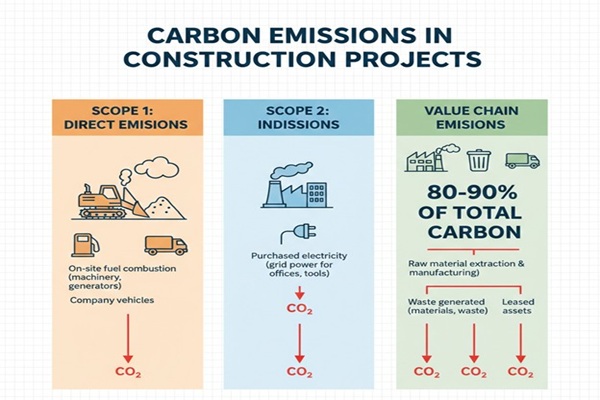
- Explain the fundamental principles of carbon accounting and its application to construction projects, including the distinction between embodied and operational carbon, Scope 1-3 emissions, and carbon dioxide equivalent calculations using global warming potential factors.
- Describe Life Cycle Assessment methodology and its application to construction carbon accounting, including system boundaries, functional units, emission factors, and uncertainty management approaches that support credible carbon quantification.
- Apply carbon accounting principles to major construction materials including concrete, steel, timber, and aluminum, identifying carbon-intensive processes and evaluating reduction strategies including material substitution, recycled content, and alternative production methods.
- Quantify construction process emissions including equipment operation, transportation, temporary facilities, and waste management, while identifying optimization strategies such as electrification, renewable energy, and circular economy approaches.
- Evaluate and implement carbon assessment software platforms and digital tools, including BIM integration, automated quantity extraction, and database management systems that streamline carbon accounting workflows.
- Develop carbon reporting strategies that align with established frameworks including the GHG Protocol, ISO standards, and emerging regulatory requirements, while understanding third-party verification processes and quality assurance requirements.
- Establish benchmarking and performance tracking systems using industry standards and comparative databases, enabling carbon target setting, progress monitoring, and continuous improvement in project carbon performance.
- Design organizational carbon management systems that integrate carbon accounting into project development processes, procurement decisions, and supply chain management, while supporting training and competency development across project teams.
- Implement supply chain engagement strategies that extend carbon accounting beyond organizational boundaries, including supplier carbon requirements, Environmental Product Declaration utilization, and collaborative carbon reduction programs.
- Evaluate emerging trends and technologies in construction carbon accounting including digital twins, automated monitoring, blockchain verification, and artificial intelligence applications that will shape future carbon management practice.