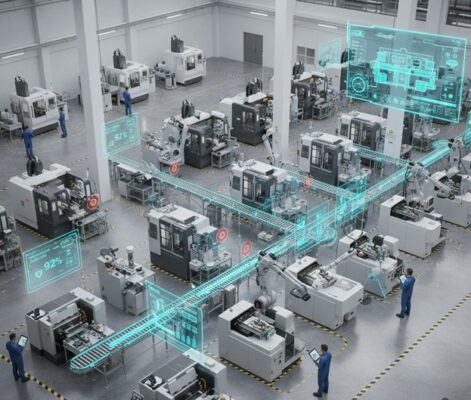
Digital twin technology represents one of the most transformative advances in industrial facility management. By creating comprehensive virtual replicas of physical assets, systems, and processes, digital twins enable unprecedented capabilities for monitoring, analysis, optimization, and predictive maintenance. The global digital twin market is projected to reach $73.5 billion by 2027, with industrial manufacturing representing the largest application segment. Organizations implementing digital twin solutions report operational cost reductions of 10 to 25 percent, maintenance cost decreases of 20 to 30 percent, and equipment downtime reductions of 30 to 50 percent compared to traditional facility management approaches.
By completing this course, you will gain practical insights into how digital twin technologies address fundamental industrial facility management challenges. Research demonstrates that digital twin-enabled predictive maintenance reduces maintenance costs by 20 to 30 percent, decreases equipment downtime by 30 to 50 percent, and extends asset service life by 20 to 40 percent compared to traditional preventive maintenance approaches. Studies by McKinsey Global Institute and Deloitte consistently report substantial returns on investment from digital twin implementation.
This course bridges the gap between digital twin technology and practical industrial applications, examining how manufacturing plants, process industries, power generation facilities, and utilities successfully deploy digital twin solutions to improve performance, reduce costs, and enhance operational reliability. You will learn the fundamental concepts underlying digital twin systems, including IoT sensor networks, data integration platforms, physics-based simulation models, and machine learning analytics. Real-world case studies demonstrate measurable benefits including improved overall equipment effectiveness, reduced energy consumption, and extended asset service life.
Whether you are an industrial engineer, facility manager, maintenance supervisor, operations director, or technology consultant, this course will equip you with the knowledge needed to evaluate digital twin technologies, develop implementation strategies, and lead digital transformation initiatives within your organization. The course addresses practical considerations including sensor technologies, data architecture design, model development methodologies, cybersecurity requirements, and organizational change management.
Learning Objectives:
At the successful conclusion of this course, you will learn the following knowledge and skills:
- Define digital twins and explain how they differ from traditional 3D models and Building Information Models, describing the key components including physical entity layer, data acquisition layer, integration layer, modeling layer, and application layer.
- Classify digital twin types including component twins, system twins, process twins, and facility twins, and identify appropriate applications for each type in industrial facility contexts.
- Describe sensor technologies for industrial digital twins including vibration, temperature, pressure, flow, and electrical sensors, and explain how each technology enables condition monitoring and predictive maintenance.
- Explain connectivity options for industrial digital twins including wired protocols, wireless technologies, and low-power wide-area networks, and identify appropriate connectivity solutions for different industrial applications.
- Describe model development approaches including physics-based models, data-driven machine learning models, and hybrid approaches, explaining the advantages and limitations of each methodology.
- Explain how digital twin-enabled predictive maintenance improves upon reactive and preventive maintenance strategies, quantifying typical improvements in downtime reduction, cost savings, and asset life extension.
- Describe process optimization and control applications including Model Predictive Control, what-if analysis, and closed-loop optimization, and identify typical performance improvements achievable through these applications.
- Evaluate digital twin platform options including industrial automation platforms, cloud IoT platforms, and specialized simulation tools, applying selection criteria appropriate to organizational requirements.
- Identify cybersecurity considerations for digital twin implementations including network segmentation, data protection, and OT/IT integration security, and explain defense-in-depth strategies for industrial applications.
- Describe emerging technologies including advanced AI, extended reality integration, and autonomous operations that will shape future digital twin capabilities for industrial facilities.