


No data found for Custom Course Number
No data found for Custom Course Units
Intended Audience: Architecture, Civil & Environmental Engineers
PDH UNITS: 1
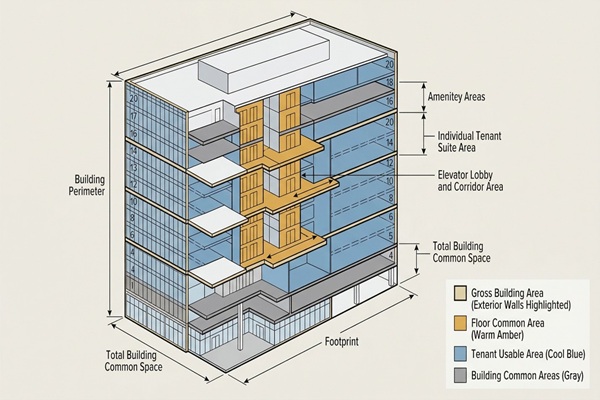
Building measurement standards form the foundation of commercial real estate transactions, affecting lease negotiations, property valuations, operating expense allocations, and market analysis across billions of square feet of commercial space. The Building Owners and Managers Association International (BOMA) has established the most widely accepted measurement standards in North America, with BOMA-compliant measurements used for over 90 percent of commercial office space. This comprehensive course introduces building professionals to the principles, methodologies, and practical applications of BOMA measurement standards. By completing this course, you will gain practical insights into how BOMA standards define usable area, rentable area, and load factors that determine tenant charges and property values. You will understand how different BOMA standards apply to office, industrial, retail, residential, and mixed-use buildings. The course examines how artificial intelligence and digital technologies are transforming measurement practice, with laser scanning reducing measurement time by 40 to 60 percent and AI-powered analysis achieving space classification accuracy rates of 85 to 95 percent. Industry research indicates that measurement errors can affect annual building revenue by hundreds of thousands of dollars, making accurate BOMA application essential for building owners, property managers, and the architects who design these spaces. This course bridges the gap between technical measurement standards and practical application in architectural practice. Whether you are an architect designing new commercial buildings, a facility manager documenting existing conditions, or a real estate professional evaluating lease terms, this course will equip you with the foundational knowledge needed to understand, specify, and verify BOMA-compliant measurements. Case studies demonstrate real-world implementations including office tower remeasurements that increased annual revenue by over $800,000 and campus-wide standardization projects that achieved 45 percent time savings through digital measurement technologies. By understanding these foundations, you will be prepared to apply BOMA standards accurately while leveraging modern tools that improve efficiency and accuracy.
Learning Objectives:
At the successful conclusion of this course, you will learn the following knowledge and skills:- Describe the evolution of building measurement standards and explain the role of BOMA International in developing and maintaining measurement standards for commercial real estate.
- Explain the importance of standardized measurements for fair lease negotiations, property valuation, operating expense allocation, and market analysis.
- Define gross building area, gross measured area, usable area, and rentable area, and explain the relationships between these measurement concepts in the BOMA methodology hierarchy.
- Calculate load factors and explain how common areas are allocated to tenant spaces using both Method A (Legacy Method) and Method B (Single Load Factor Method) under the BOMA 2017 Office Standard.
- Distinguish between BOMA standards for different building types including office, industrial, multi-unit residential, retail, and mixed-use properties, and identify the appropriate standard for specific project applications.
- Describe digital measurement technologies including laser scanning, mobile mapping, and drone-based capture, and explain how these technologies improve the speed, accuracy, and completeness of BOMA measurements.
- Explain how artificial intelligence applications including computer vision, automated boundary detection, and natural language processing support BOMA-compliant area calculation and space classification.
- Describe BIM integration approaches for BOMA compliance, including room configuration, area scheduling, and the use of third-party plugins for automated BOMA calculation.
- Identify common BOMA measurement errors including incorrect standard application, inconsistent dominant portion treatment, space misclassification, and vertical penetration errors, and describe strategies for error prevention and quality assurance.
- Recognize emerging trends in building measurement including flexible workspace considerations, international standards harmonization, and digital twin integration, and identify professional and ethical responsibilities for measurement accuracy and transparency.
ACCEPTANCE GUARANTEE
Ncite Engineering Hub engineering courses & live webinars meet NCEES Guidelines for Professional Engineer licenses renewal in all 50 states.

Live Webinars satisfy strict “Live Contact Hour” state mandates.
100% money-back State Board Acceptance Guarantee
Ncite Engineering Hub will refund your payment if the PDH credits you earn are rejected by your state board for any reason.

Ethics Courses

E – 1206 Ethical Issues – Tacoma Narrows Bridge Collapseby Mr. J. Paul Guyer, P.E., R.A.

E – 3123 Engineering Ethics Fundamentalsby Dr. M. A. Karim, P.E., BCEE, F.ASCE

E – 2043 Florida Laws and Rules for Professional Engineers Biennium Cycle 2023-2025by Mark P. Rossow, PhD, P.E.

E – 1934 Engineering Ethics: “Hold Safety Paramount” to Prevent Loss of Life, and the Case of Columbia Shuttle Disasterby Dr. Abolhassan Astaneh-Asl, Professor Emeritus. Ph.D., PE
Once completed, your order and certificate of completion will be available in your profile when you’re logged in to the site.