

No data found for Custom Course Number
No data found for Custom Course Units
Intended Audience: Electrical and general engineers
PDH UNITS: 5
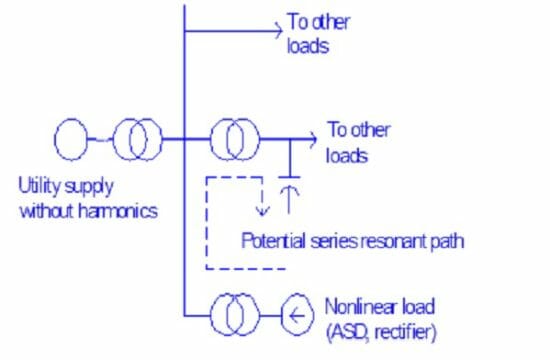
A harmonic-producing load can affect other loads if significant voltage distortion is caused. The voltage distortion caused by the harmonic-producing load is a function of both the system impedance and the amount of harmonic current injected. The mere fact that a given load current is distorted does not always mean there will be undue adverse effects on other power consumers. If the system impedance is low, the voltage distortion is usually negligible in the absence of harmonic resonance. However, if harmonic resonance prevails, intolerable harmonic voltage and currents are likely to result. The general procedure is to first develop a model that can accurately simulate the harmonic response of the present system and then to add a model of the new addition. Analysis is also commonly done to evaluate alternatives for correcting problems found by measurements. Only very small circuits can be effectively analyzed without a computer program. Typically, a computer program for harmonic analysis will provide the engineer with the capability to compute the frequency response of the power system and to display it in a number of useful graphical forms. The programs provide the capability to predict the actual distortion based on models of converters, arc furnaces, and other nonlinear loads. This course provides an introduction to harmonic theory. This course is suitable for electrical engineers with a desire to understand the fundamentals of harmonic phenomena and power quality in general. Upon successful completion engineers will be able to address various power quality phenomena, understand how electrical systems are modelled for the purpose of harmonic calculations and how harmonic filters are sized. Learning Objectives. Specific Knowledge or Skill Obtained This course teaches the following specific knowledge and skills:
- Fundamentals of harmonic phenomena and general power quality theory
- Purpose of harmonic study
- System modelling
- Remedial measures (harmonic filter sizing)
- Harmonic standards
- Example
ACCEPTANCE GUARANTEE

Ncite Engineering Hub engineering courses & live webinars meet NCEES Guidelines for Professional Engineer licenses renewal in all 50 states.
Live Webinars satisfy strict “Live Contact Hour” state mandates.
100% money-back State Board Acceptance Guarantee
Ncite Engineering Hub will refund your payment if the PDH credits you earn are rejected by your state board for any reason.
Ethics Courses

E – 1975 Indiana Statutes and Rules for Professional Engineers 2022-2024 Bienniumby Mark P. Rossow, PhD, P.E.

E – 1209 – Ethical Issues – Kansas City Hyatt Hotel Collapseby Mr. J. Paul Guyer, P.E., R.A.

E – 1934 Engineering Ethics: “Hold Safety Paramount” to Prevent Loss of Life, and the Case of Columbia Shuttle Disasterby Dr. Abolhassan Astaneh-Asl, Professor Emeritus. Ph.D., PE

E – 1154 – Ethics in Professional Practiceby Mark P. Rossow, PhD, P.E.
Once completed, your order and certificate of completion will be available in your profile when you’re logged in to the site.