
No data found for Custom Course Number
No data found for Custom Course Units
Intended Audience:: Engineers interested in electrical power systems. Technicians, and Electricians.
Credits: 2 PDH Units
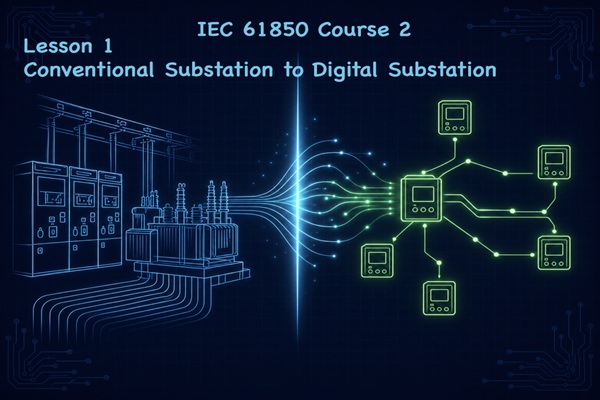
This follow-up course is designed to take an entry-level student beyond a simple introductory understanding of IEC 61850 and into the practical engineering workflow used in real digital substations. The emphasis is on explaining the system step by step in very simple language, while still introducing the student to the actual file types, communication methods, and testing ideas used in the field.
Why this course is needed
An introductory IEC 61850 course explains what the standard is and why it matters, but the next practical step is to show how an actual IEC 61850 system is engineered, configured, and tested in a substation environment. Industry training beyond the basics commonly moves into Substation Configuration Language (SCL), communication services such as GOOSE, MMS, and Sampled Values, and practical testing and troubleshooting.
This makes a system-level, multi-vendor course a stronger next step than a course focused only on one relay model, because the student first needs to understand the engineering process that applies across many Intelligent Electronic Devices (IEDs). A relay-specific drill-down such as an SEL-710 example can still be used inside the course as a worked example, but it should support the system explanation rather than replace it.
Learning Objectives
At the successful conclusion of this course, you’ll be able to identify and discuss:- Explain, in simple terms, how IEC 61850 is used to engineer and operate a digital substation.
- Describe the meaning and purpose of Substation Configuration Language, or SCL, and identify the role of ICD, CID, and SCD files.
- Explain what an Intelligent Electronic Device, or IED, is and how logical devices, logical nodes, data objects, and data attributes are used to organize information.
- Distinguish between GOOSE, which means Generic Object Oriented Substation Event, MMS, which means Manufacturing Message Specification, and Sampled Values, and explain where each is used.
- Describe, at an introductory level, how communication networks, redundancy, and time synchronization support IEC 61850 systems in substations.
- Explain the basic idea of IEC 61850 testing, including simulation, test mode, and simple troubleshooting steps.
- Read a simple SCL-based engineering story from the system level down to a single IED configuration.
ACCEPTANCE GUARANTEE
Ncite Engineering Hub engineering courses & live webinars meet NCEES Guidelines for Professional Engineer licenses renewal in all 50 states.
Live Webinars satisfy strict “Live Contact Hour” state mandates.
100% money-back State Board Acceptance Guarantee
Ncite Engineering Hub will refund your payment if the PDH credits you earn are rejected by your state board for any reason.
Ethics Courses

E – 1955 Illinois Statutes and Rules for Professional Engineersby Mark P. Rossow, PhD, P.E.

[Live Webinar] Engineering Ethics: Baltimore Ship and Bridge Collision; Ethics Violation Caused Six Deathsby Dr. Abolhassan Astaneh-Asl, Professor Emeritus. Ph.D., PE

E – 1428 An Alternative Account of the Ford Pinto Caseby Mark P. Rossow, PhD, P.E.

E – 1771 Climate Change: Facts & Solutions; An Ethical Challenge For Engineers and Architectsby Professor Roger Messenger, Ph.D., P.E.
Once completed, your order and certificate of completion will be available in your profile when you’re logged in to the site.
Course No E - 3148
PDH Units: 2