

Ncite Engineering Hub engineering courses & live webinars meet NCEES Guidelines for Professional Engineer licenses renewal in all 50 states.
$25.00
The structural integrity of buildings, bridges, dams, and other critical infrastructure represents a fundamental public safety concern. Traditional structural inspection methods rely on periodic visual assessments and manual testing that provide only snapshots of structural condition at discrete moments. These approaches cannot detect gradual deterioration between inspection intervals, may miss critical damage in inaccessible locations, and require significant time and expense to execute comprehensively.
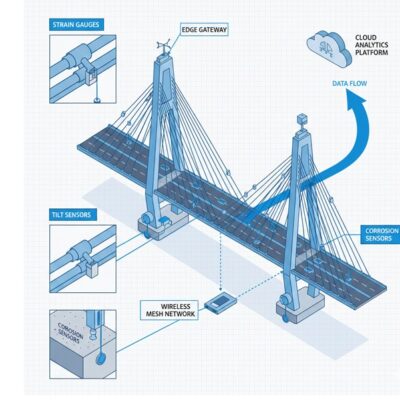
The Internet of Things (IoT) has emerged as a transformative technology for structural health monitoring, enabling continuous real-time assessment of structural performance through networks of interconnected sensors, data transmission systems, and analytical platforms. IoT-based monitoring systems can detect subtle changes in structural behavior, identify emerging damage before it becomes critical, and provide engineers with unprecedented insights into how structures respond to environmental loads, operational demands, and aging processes.
According to the American Society of Civil Engineers, the United States faces a USD 2.6 trillion infrastructure funding gap over the next decade. Research by McKinsey Global Institute indicates that IoT-based monitoring systems can reduce infrastructure maintenance costs by 20 to 30 percent while extending asset service life by 15 to 25 percent through early damage detection and optimized maintenance timing. The Federal Highway Administration reports that continuous monitoring systems can reduce bridge inspection costs by 40 to 60 percent compared to traditional hands-on inspection methods while providing superior damage detection capabilities.
This course provides comprehensive coverage of IoT applications in structural health monitoring for civil engineers, structural engineers, and infrastructure professionals. You will learn how wireless sensor networks, data acquisition systems, cloud computing platforms, and analytical algorithms work together to provide continuous structural assessment. The course examines sensor technologies for measuring strain, displacement, vibration, corrosion, and environmental conditions. You will understand data transmission protocols, power management strategies, and edge computing architectures that enable reliable long-term monitoring. The course covers advanced analytical techniques including machine learning for damage detection, digital twin implementations, and predictive maintenance strategies.
Only logged in customers who have purchased this product may leave a review.
Reviews
There are no reviews yet.