
No data found for Custom Course Number
No data found for Custom Course Units
Intended Audience: for civil, mechanical, environmental, and electrical engineers
PDH UNITS: 1
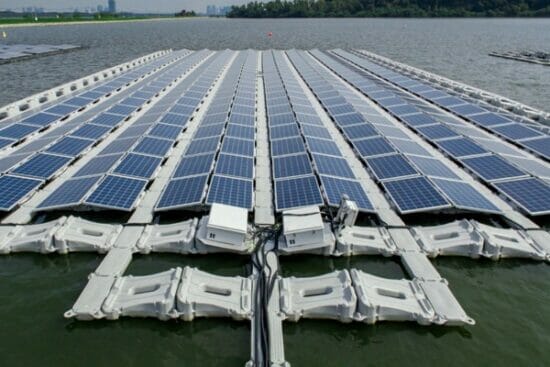
Floating Solar Photovoltaic Systems Cost Benchmark: Q1 2021 Installations on Artificial Water Bodies. In this online engineering PDH course, the costs of solar photovoltaic systems installed on floats anchored in bodies of water are estimated. Typical bodies of water used include industrial ponds, hydropower reservoirs, agricultural ponds, and flood control reservoirs. Floating photovoltaic (FPV) systems are advantageous in places where land use is constrained, land is not easily accessible, or land leasing is expensive and a body of water is available. In this course, an analysis of the installed costs for a FPV system constructed for average site conditions shows that the FPV system costs are approximately 25% higher than ground-mounted, fixed-tilt PV installed over bare ground. Higher structural costs related to the floats and anchoring system are the largest contributors to the increased cost. FPV deployment is in an early stage, and additional experience, best practice development, and new configurations and technologies might help reduce the costs of FPV systems over time. This course is based on the National Renewable Energy Laboratory report: Ramasamy, Vignesh and Robert Margolis. 2021. Floating Photovoltaic System Cost Benchmark: Q1 2021 Installations on Artificial Water Bodies. Golden, CO: National Renewable Energy Laboratory. NREL/TP-7A40-80695. https://www.nrel.gov/docs/fy22osti/80695.pdf.
Learning Objectives
At the successful conclusion of this course, you’ll be able to identify and discuss:- Learning how to apply bottom-up modeling methods to calculate the capital costs associated with FPV application for different site characteristics and system design types
- Knowing global PFV deployment data
- Understanding FPV system design assumptions
- Recognizing key cost components of FPV systems
Course Reviews
3
- 5 stars0
- 4 stars0
- 3 stars1
- 2 stars0
- 1 stars0
ACCEPTANCE GUARANTEE

Ncite Engineering Hub engineering courses & live webinars meet NCEES Guidelines for Professional Engineer licenses renewal in all 50 states.
Live Webinars satisfy strict “Live Contact Hour” state mandates.
100% money-back State Board Acceptance Guarantee
Ncite Engineering Hub will refund your payment if the PDH credits you earn are rejected by your state board for any reason.
Ethics Courses

E – 1742 Ethics: Determining Negligence in Engineering Failuresby Mark P. Rossow, PhD, P.E.

E – 1935 Engineering Ethics: The Millennium Tower Sinking and Tilting- the Root Cause Was Engineering Ethics Violationsby Dr. Abolhassan Astaneh-Asl, Professor Emeritus. Ph.D., PE

E – 1673 How to Interview to Win Engineering Projects – Ethical Implicationsby Dr. David Williams. PhD, PE, PH, CFM, F.ASCE, CPESC, D.WRE

E – 2012 Engineering Ethics—Case Studies in Briberyby Mark P. Rossow, PhD, P.E.
Once completed, your order and certificate of completion will be available in your profile when you’re logged in to the site.


Very light on subject matter. Too many assumptions. I’m sure that when more real-life data becomes available from more actual installations, this will change. Then again, it is only 1 PDH.